MongoDB
MongoDB is a popular open-source NoSQL database that stores data in flexible, JSON-like documents. It is designed to handle large volumes of diverse data and is widely used for high-performance, scalable applications, particularly in environments requiring unstructured data management.

Integrating MongoDB with Timbr allows you to leverage Timbr's semantic graph capabilities while utilizing MongoDB's document-based, schema-flexible architecture. This integration enables advanced features like semantic querying, data virtualization, and integrated data management, providing powerful insights and efficiencies across your unstructured data.
Getting Started with MongoDB
If you haven't yet set up MongoDB, follow these steps to get started:
To connect Timbr to your MongoDB datasource, you need to use the MongoDB JDBC driver. For information on the MongoDB JDBC driver and how to set it up, refer to the MongoDB JDBC Driver documentation.
Connecting Timbr to MongoDB in the Timbr Platform
Once you've set up MongoDB and have the JDBC driver ready, it's time to connect Timbr to MongoDB. Follow the steps below for a detailed tutorial on connecting Timbr to MongoDB:
Navigate to Manage Datasources: From the Timbr interface, click on the Manage tab and select Datasources.
Add New Datasource: On the top right, click the Add New Datasource button. Alternatively, you can click the big add button beneath the knowledge graphs and datasources tabs.

- Fill in Connection Details: A pop-up window will appear where you need to provide the relevant connection details to connect MongoDB to Timbr.
There are two options in Timbr to enter the connection information: Simple or JDBC Url.
On the top right of the pop-up window, the toggle can be switched from Simple to JDBC Url in order to connect the datasource using the relevant JDBC URL.
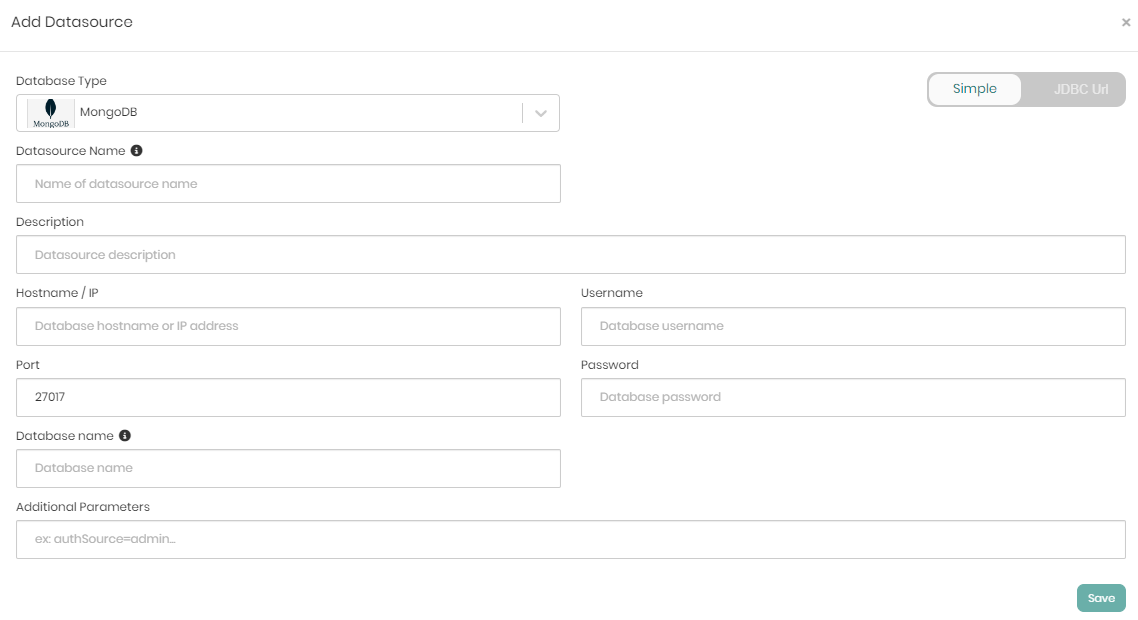
Simple Tab Connection Configuration
Select Simple Tab: Ensure the Simple tab is selected.
Fill in the Following Details:
- Database Type: Select MongoDB.
- Datasource Name: Enter a name for your datasource.
- Description: Provide a description of the datasource (Optional).
- Hostname / IP: Enter the hostname or IP address of your MongoDB datasource.
- Port: Enter the port number (default is 27017).
- Username: Enter your MongoDB username.
- Password: Enter your MongoDB password.
- Database Name: Specify the name of the database.
- Additional Parameters: Add any additional connection parameters using
;as separators.
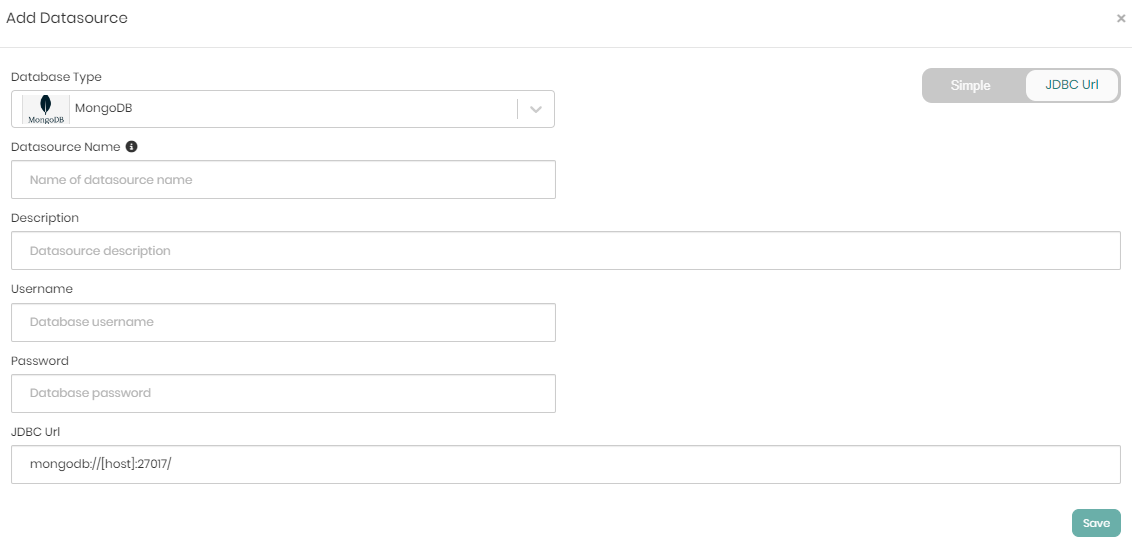
JDBC URL Tab Configuration
Select JDBC URL Tab: Ensure the JDBC URL tab is selected.
Fill in the Following Details:
- Database Type: Select MongoDB.
- Datasource Name: Enter a name for your datasource.
- Description: Provide a description of the datasource (Optional).
- Username: Enter your MongoDB username.
- Password: Enter your MongoDB password.
- JDBC URL: Enter the JDBC connection URL (e.g.,
mongodb://hostname:port/database).
Save and Test Connection
- After entering the details, click the Save button to save the information, connecting the MongoDB datasource to the Timbr environment.
- Once saved, on the top right, click the Test connection button to verify the datasource’s connectivity, ensuring it is active and responsive.
For a comprehensive guide on connecting Timbr to various datasources, refer to the detailed documentation: